| Historical data on ear trumpets | ||||
| Ear trumpets are notoriously difficult to date, F C Rein (UK) seems to be the earliest quantity manufacturer starting in 1800, but probably not making trumpets until 1850, although many have been home-made both before and after. View our list of makers. There is an excellent time line at Becker. Trumpets made from horns, sea shells, or other natural material probably existed long before the ear trumpet was first manufactured. Read about the Banjo Conundrum Red borders link to more information and magnifying icons link to larger versions of the associated image |
||||
| Much of this data and most of the images have been borrowed from established resources - I believe all copyright has expired but if further credit or linking is required please let me know If you wish to use my pictures - please have the courtesy to ask ! |
||||
| King Tutankhamun's tomb 1332 BC |
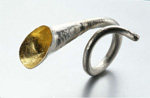 |
King Tut ruled during the New Kingdom 1332-1323 BC. This silver horn with a gilt lining found in his tomb is too like small Victorian ear trumpets to be something blown. |
||
| Greek Empire 800 BC to 146 AD |
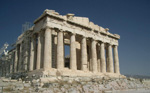 |
The Greeks notoriously put the deaf to the sword. They also have documentation of the earliest sign language. |
||
| 400 BC | 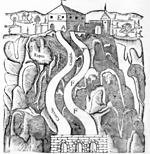 |
A pipe for conveying the sound laid between the dungeons at the foot of the mountain made by Dionysos in Sicily and the guard room at the summit in the book "Problems of the Deaf" by Goldstein around 400 BC Illustration. The purpose is explained to eavesdrop on prisoners' conversations and detect jailbreak plans in advance. |
||
| early history |
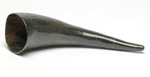 |
Horns from animals and sea shells were used for hunting in early times. Possibly these items were reversed for listening but I can find no documents to suggest this. | ||
| Emperor Hadrian b.76 reigned 117-138 |
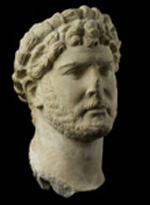 |
Contemporary court descriptions tell of Hadrian cupping his hand behind his ear in order to hear better. He also is recorded as wearing small parchment cups behind his ears and having his throne in a concave alcove to reflect sounds. Galen described Consul Flavius Arrianus using cupped hands. |
||
| 2nd century AD Claudius Galenus 129 - ~210 |
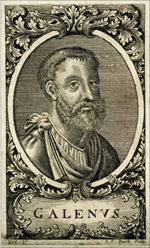 |
The Greek physician, Galenus wrote about bone conduction in the book De Subtilitate (image is 18th century) |
||
| 13th century |  based on Victorian shell |
You would have used an "Eustachian" if you had been hard of hearing in the 13th century. These were made from hollowed-out animal horns, shells or glass |
||
| Rudolphus Agricola 1443-1485 |
 |
Agricola wrote a book called De Inventione Dialectica Folk born deaf can express themselves in writing it was 100 years before the the book was published. |
||
| Pedro Ponce de Leon 1520-1584 |
 |
A Catholic monk who founded the first school for the deaf at the Monastery of San Salvador, Madrid. He taught deaf kids to speak and write so that they would be permitted to inherit their family's property. |
||
| Girolama Cardano (1501-1576) pub 1551 |
 |
Cardano an Italian doctor, philosopher, and mathematician, wrote about “De Subtilitate” about bone conduction. 'How is the sound transmitted through the handle of the heel and heel in the mouth?' is described. Cardano tried using a code of symbols to teach his own son. |
||
| Giovanni Battista Porta 1535 ? - 1615 pub 1558 |

|
Porta an Italian doctor, scientist and cryptographer, described in a book called Natural Magick, wooden ear shaped cups to fit over the ears. |
||
| Capivacci pub 1603 |
 |
Experiments with bone conduction devices for teaching deaf mutes. Image shows 1890 instruction detail for the Dentaphone |
||
| Paolo Aproino 1612 |
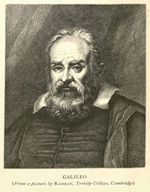 Galileo |
Aproino, a pupil of Galileo’s developed the first ear trumpet, but it seems the project was abandoned. more information |
||
| G Bonifacio (1547-1635) 1616 |
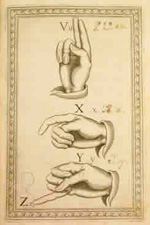 |
Giovanni Bonifacio publishes 'Of the Art of Signs'. |
||
| Juan Pablo de Bonet (1573–1633) 1620 |
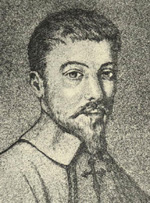 |
A Spanish monk who used his own variation of proven methods in teaching the deaf. In 1620, Bonet published the first book on instructional methods for teaching deaf people. |
||
| Leurechon, Jean (c.1591–1670)
pub 1624 |
Encyclopedia of Science French Jesuit priest and mathematician who maybe wrote Recreations Mathématiques |
This work describes the basic acoustics of buildings and their adaptations.
The book also gives an early description of the operation of an ear trumpet and early listening tubes. |
||
| Francis Bacon 1627 |
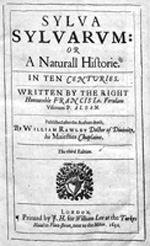 |
Sylva Sylvarum: A Natural History', by Francis Bacon: Let it be tried, for the help of hearing, (and I conceive it likely to succeed) to make an instrument like a tunnel; the narrow part whereof may be the bigness of the hole of the ear; and the broader end much larger, like a bell at the skirts; and the length half a foot or more. And let the narrow end of it be set close to the ear: and mark whether any sound, abroad in the open air, will not be heard distinctly from further distance than without that instrument... ...And I have heard there is in Spain an instrument in use to be set to the ear, that helpeth somewhat those that are thick of hearing. |
||
| Pietro Amiani 1640 |
 parabolic trumpet dated 1803 |
'Hearing Instruments for Those with Weakened Hearing' - a section of his book Geometria. Amiani describes a desirable ear trumpet that had a 'sophisticated parabolic design'. |
||
| John Bulwer (1614-1684) pub 1644 |
 |
Published in 1644, one of the earlist records of the use of hand signs. |
||
| 1644 |  |
This is amazing ! |
||
| Philocophus J Bulwer pub 1648 |
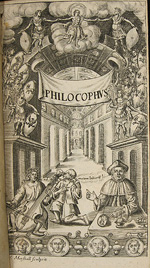 |
Bulwer wrote about education of the deaf and using sign language. |
||
| Athanasius Kircher (1662-1680) Title: Musurgia universalis sive ars magna consoni et dissoni in X. libros digesta Place of Publication: Rome |
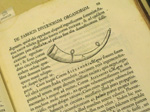
image Becker |
It is fairly clear that the Greeks and Egyptians made hearing trumpets out of animal horns, Kircher details this. More information about Kircher’s Musurgia, as well as information about Max Goldstein’s book collection |
||
| Publisher: Ex typographia haeredum Francisci Corbelletti, anno Iubilaei pub 1650 |

image Becker |
This is a scientific work which suggests that an ear trumpet should be 'tuned'. |
||
 |
In this picture we see the earliest found documentation of using large hearing aids in buildings. This technique is also recorded as being used to listen to prisoners' conversations |
|||
 |
An illustration showing how the music played inside the building can be heard and enjoyed by people outside the building. © itscom |
|||
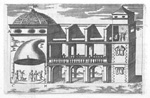 |
This illustration shows how the audio in a dome-shaped building is delivered to a remote location © itscom |
|||
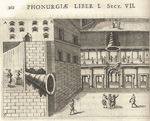 |
This illustration shows how a person in a room inside a building could eavesdrop on people talking in the street outside by means of a sound receiver |
|||
 © Becker |
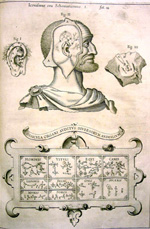
an image showing Kircher's ear details
|
|||
| Wolfgang Hoefer (1614-1681) 1657 |
 Hoefer ? © Oir Vital |
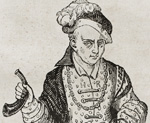
Hoefer, a German professor of pharmacology, wrote in his book 'Herculis Medici, Sive Locorum Medicorum', that hearing aids (ear trumpet) are used in Spain. A writing appears on an instrument called 'sarvatana' made of silver or bronze and, as stated in the document: 'it is like a funnel whose main part is addressed towards the speaker, while the minor part is inserted into the ear '. |
||
| Francis Bacon (1561-1626) pub 1665 |
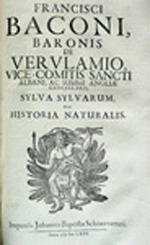 |
His work was published in 1665 and describes ear 'spectacles' as an ear trumpet or speaking tubes. 'Let if be tried, for the help of hearing... to make an instrument like a tunnel; the narrow part whereof may be the bigness of the hole of the ear; and the broader end much larger, like a bell at the skirts... And let the narrow end of it be set against the ear; and mark whether any sound... will not be heard distinctly from further distance than without that instrument; being (as it were) an ear-spectacle.' |
||
| Multisegmented Hearing Trumpet 1670 |
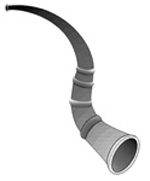 |
Building up the device from separate pieces facilitated shaping it to direct sound from the user's front into his or her 'good' ear. |
||
| Sir Samuel Moreland (1625-1695) pub 1671 |
 |
Claimed to have invented the first speaking trumpet. |
||
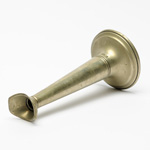 |
Several were claimed to have been made, one is located at Cambridge University. One was over 20 feet in length. This is my #199 from 1873 and 248mm long |
|||
| Kircher, Athanasius (1602-1680) pub 1673 Publisher: Per Rudolphum Dreherr |
 © WUSM |
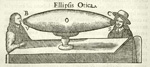
The 'Ellipsis Otica' is one of the oldest illustrations of a hearing aid. |
||
| Title: Phonurgia nova sive conjugium mechanico-physicum artis & naturae paranympha phonosophia concinnatum … | 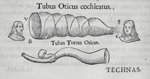 © WUSM |
This is the earliest publication that I have found where something beyond an animal horn is shown. |
||
| Place of Publication: Campidonae [Kempten, Bavaria, Germany] | 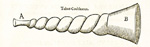 © WUSM |
More information about Kircher’s Phonurgia |
||
| Dekker 1673 |
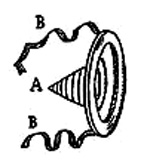
image Robert Weinkove |
One of the earliest attempts at an actual trumpet see Luer 1912 below |
||
| Antonias Nuck 1692 |
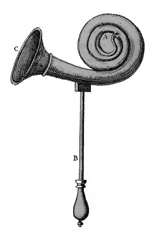
|
Nuck is credited with this design |
||
| Early music print |  |
Shows the Nuck design, suggesting it may have been built. |
||
| Frederik Dekkers 1694 |
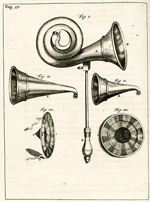 |
An engraving of hearing aids from Exercitationes Practicæ circa Medendi Methodum by Dekkers. |
||
| William Bull (1650-1712) 1700 |
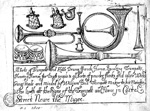 |
William Bull has traversed the centuries with the reputation as a fine maker of brass musical instruments while at the same time remaining a somewhat enigmatic figure. |
||
| Duguet 1706 |
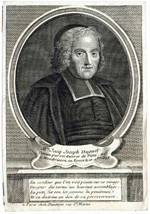 |
Duguet uses built-in tubes for receiving sound waves in the arms of a chair. |
||
| Christoph Stephanus Kazaver 1713 |
|
His De tuba stentorea focuses on the amplification and transmission of sound. The illustration at the top is a sound amplification device. The device at the bottom is similar to a musical instrument. |
||
| R James (1703?-1776) 1743 |
 © Wellcome |
The bones of the ear and of hearing. Etching
|
||
| Giuseppe Mastiani (1715-1756) 1743 |
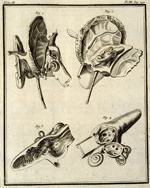 © Wellcome |
Limewood models of the ear. Engraving, 1749. According to Buffon, these limewood models of the organs of hearing were made four times the size of life by Mastiani, a Sicilian physician. |
||
| Joshua Reynolds (1723-1792) 1752 |
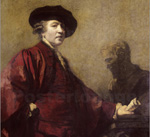 |
Joshua Reynolds spent over two years in Italy, where he studied the Old Masters and acquired a taste for the 'Grand Style'. Unfortunately, whilst in Rome, Reynolds suffered a severe cold which left him partially deaf and, as a result, he began to carry a small ear trumpet with which he is often pictured. Around this time funnel-shaped and conical-shaped hearing aids (ear trumpet) became widespread, and some of them were folding. Popular models were the Townsend Trumpet, the Reynolds Trumpet, and the Daubeney Trumpet. |
||
| Johann Zoffany 1756 ? |
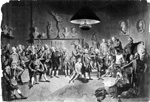 |
The print represents Sir Joshua Reynolds, President of the Royal Academy at Somerset House. He is holding his ear trumpet. To his left is Dr. William Hunter who was Professor of anatomy at the Academy and is directing the arrangement of a male model. |
||
| Joannes Jorrison 1757 |
Science paper on Bone Conduction | German merchant Jorrison snr. rediscovers that bone conduction becomes a hearing aid. When Jorrison was sitting on the side of the harpsichord (the keyboard instrument that was the predecessor of the piano) with a pipe in his mouth, he accidentally touched the pipe. And I discovered that the music can be heard clearly the moment I touch it. Jorrison thought that the sound could be heard clearly through the pipe with the mouth. And this fact was taken up in an academic paper by his son Joannes Jorrison and published in 1757. |
||
| Dr Cat 1757 |
 |
In 1757, Dr. Claude-Nicolas Le Cat invented the first hearing aid, the ear trumpet. He imagines a horn made of metal and brass. The first prosthesis amplifies hearing about 15dB. Very important invention, which will suffer only very few changes and will still be used in 1925. |
||
| Hogarth's Cockfight 1759 |
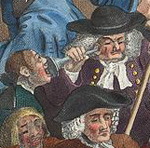 |
Detail from the classical work - interesting that it looks straight ! |
||
| Thomas Braidwood (1715-1806) 1760 |
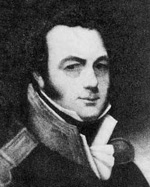 |
Founded the first British School for Deaf in Edinburgh in 1760, which moved to London in 1783 - he recommended the 2 hand alphabet still in use
|
||
| The Hare, Hatchel & Hearing 1763 |

|
Engraved by T. Jefferys Fine original antique engraved print. Printed in the mid 18th century on quality paper which retains its inherent structural flexibility and soundness. Sheet measures c. 5 1/4" W x 8 3/8" H. Engraved area measures c. 4 1/8" W x 7 3/8" H. |
||
| Joshua Reynolds self portrait 1773 |
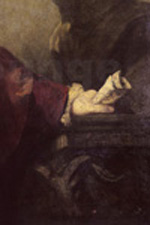 |
Detail from the classical oil painting. | ||
| ~1775 | 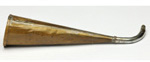 |
Personal hand made trumpets recorded. Originators like Townsend, Daubeney and for Joshua Reynolds. |
||
| Chair for deaf persons 1780 |
 |
A chair designed for use by the deaf. Incorporating a hearing device. Engraving with etching. 1770/1830? The trumpet is fitted behind the chair - seen in largest image © Wellcome |
||
| Abbe Charles Michel de L'Epee (1712-1789) ~1780 |
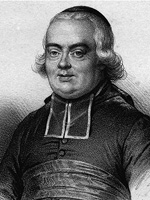 |
The Abbe was a philanthropic educator of 18th-century France who has become known as the 'Father of the Deaf'. |
||
| Samuel Heinickle (1727-1790) ~1782 |
 |
A German educator who taught his students speech by having them feel the vibrations of his throat as he spoke. | ||
| James Hutton (1726-1797) 1785 |
 |
Hutton with his ear trumpet. |
||
| F C Rein 1800 Rein chair |
 |
The oldest commercial manufacturer of hearing aids (Rein) was established by 1850, and ceased trading in 1963. His most famous device was probably the 'acoustic throne' of King Goa VI of Portugal. Manufactured in 1819, the sound collectors were the mouths of sculpted lions within the arms of the throne and was used 1820-1826. A copy used to be in the Amplivox collection but it was donated to a museum around 2018. UPDATE the Rein chair copy is located at the Museum of Liverpool. |
||
| Trumpet 1802 |
|
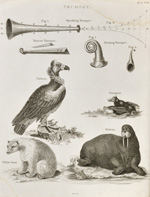
Antique Print of Trumpet Speaking Hearing Vulture Vampire Walrus Bear. I have a copy of the print. |
||
| Samuel De Wilde
(1761-1832) 1808 |
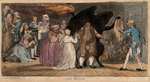 |
Drunken and diseased people attending the wedding of William Huntington and the rich widow Sanderson; behind Huntington is a devil handing breeches to a hack journalist. Coloured etching by Wilde. © Wellcome |
||
| Johann Nepomuk Malzel 1812 |
 © Joseph Karl Stieler |
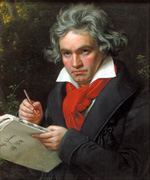
Makes ear trumpets for Ludwig von Beethoven over several years, now kept in the Beethoven Museum in Bonn. |
||
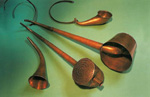 image credit Beethoven Haus |
|
|||
| D J Larrey (1766-1824) 1815 |
 |
He developed a listening helmet for Napoleon's armies based on on a pair of auricles | ||
| René Théophile Hyacinthe Laënnec (1781-1826) 1816 |
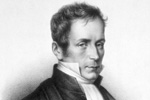 |
French physician René Laënnec 'invents' the stethoscope to listen for heart sounds.
|
||
 |
Early monaural stethoscope The 'pinard' was much later in 1895. |
|||
| J H Curtis 1817 |
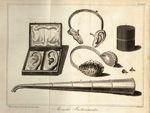 © Becker |
John H Curtis who designed a chair also proposed trumpets. Some were made by J&S Maw. This leaf shows several 'Acoustical Instruments' of the early 19th century. In the foreground is a collapsible ear trumpet; its case is shown on the upper right. The case on the left holds the 'French Artificial Ear' – on the left is the internal side, on the right is the external side. At the middle top are 'German Silver Ears.' The 'Spanish Ears' are shown in the center. And to the center, right are 'The Tubes'. |
||
| Thomas Hopkins Gallaudet 1817 |
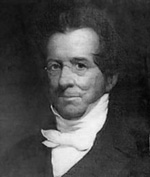 |
Gallaudet co-founded the first institution for the education of the deaf in North America | ||
| J A Duncker (1767-1843) 1819 |
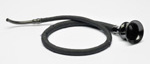 |
The conversation tube was first patented in 1819 by Johann A. Duncker. This one has 4 characteristic holes in the horn. |
||
| Joao's chair 1820 |
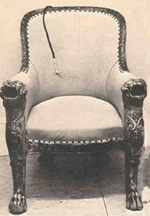 |
Reputed to be made by Rein in 1819, but disputed. The chair was supposed to have been used by the King of Portugal. |
||
| M G Itard (1773-1838), 1821 |
 |
Jean Marie Gaspard Itard published in Paris a book containing several illustrations of hearing devices, such as ear trumpets and Itard’s bone conduction hearing device. Several hearing devices are described in Itard’s work, including a membrane trumpet, a seashell trumpet and a rod-shaped device using bone conduction. |
||
| Thomas Buchanan 1823. |
 © Wellcome |
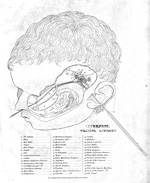
Engraving showing anatomy of the ear. Text reads: An external and internal view of the organ of hearing in situ. © Wellcome |
||
| Hannah Thatcher 1823 |
 © Wellcome |
Miss Hannah Thatcher, born deaf & dumb who was presented to the late Queen Charlotte on acquiring the sense of hearing & the faculty of speech under the treatment of Mr. Wright, her Majestys surgeon aurist. Drawn by Miss R.E. Drummond. Engraved by J. Rogers. © Wellcome |
||
| Nathaniel Pointer 1828 |
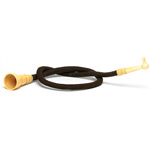 |
Conversation tubes were 'invented' by Nathaniel Pointer in 1828. There are several examples of tubes being used earlier. |
||
| Drapier 1829 |
 |
Starts manufacture, probably ceased in 1940 In English this is a 'London Dome', in USA it was 'Dr Scotts Resonator' and in France 'Cloche Parabolique' |
||
| Miss Eve Greene (1801-1833) 1830 |
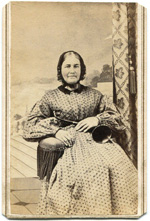 |
An early print of the actress Miss Greene, later Mrs. Paul Bedford. She has a large trumpet in her lap. |
||
| Rein ear tube 1830 |
 |
Made of gold-plated silver with a beautiful ear-shaped (outer ear) hearing aid manufactured by F C Rein and made in order to match hairstyles and accessories when worn. The actual effect is 1.5 kHz and the gain is 13 dB. This type is quite suitable for mild hearing loss. © itscom |
||
| D J Larrey (1776-1842) ~1830 |
 © Wellcome |
Hearing aid for constant use. Two light cornets of imitation tortoiseshell joined by metal spring forming a head-band. Introduction of this form of instrument attributed to Napoleon's surgeon D. J. Larrey. © Wellcome |
||
| Cartoon 1830 |
 © Wellcome |
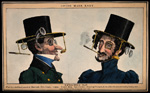
Living made easy. Revolving hat. Which by a slight touch presents its wearer with, eye-glass, cegar, scent-box, spectacles, hearing-trumpet, &cc, &cc, without the intolerable trouble holding them. |
||
| J H Curtis 1836 |
 © Becker |
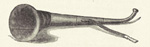
Curtis invented this ear trumpet with two apertures, one to be inserted into the meatus and the other into the mouth – the user thus receiving sounds by both the external auditory passage and by the Eustachian tubes. | ||
 © Becker |
Curtis claims to have invented this telescoping trumpet 'some years ago', extolling its virtue of collapsing into a small case to be carried in a pocket. | |||
 © Becker |
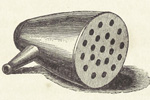
Curtis credited the invention of this small tin ear trumpet to Don Consul Jovis at Cadiz.
Curtis wrote that 'in some cases it is found to be of considerable benefit; but still I must, once for all, assure my readers, that it is useless ever to expect to hear so well with a short trumpet, however excellent, as with a long one'. |
|||
| Patent application A W Webster 1836 |
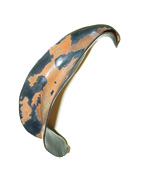 |
First known British patent for a hearing aid is issued to Alphonsus William Webster for a curved earpiece worn behind the ear. This was called Webster's Otaphone. |
||
| Curtis acoustic chair 1837 |
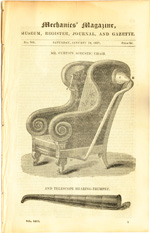 |
This 8pp pamphlet (I have the original) describes the chair in the Mechanics Magazine 14 Jan 1837. The chair was built by J & S Maw of 11 Aldersgate Street. |
||
| The Soniferon 1838 |
 |
William B. Pine, offering the Soniferon, a sort of table based ear trumpet that 'stands on a pillar like a lamp'. credit |
||
| Meyers Lexicon 1839 |
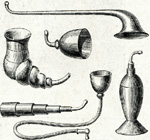 |
Found in a German encyclopaedia. |
||
| Nathaniel Pointer 1839 |
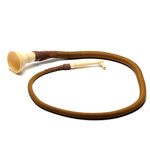 |
Seems to be the first person to use conversation tubes between 60cm and 1 metre long (Although very long tubes were used in large old houses to call servants much earlier) This date is the start of vulcanisation and Pointer definitely made something at this time - the image shows an early ivory example The tube is a fabric covered metal spiral (most are helical). |
||
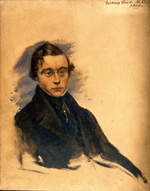
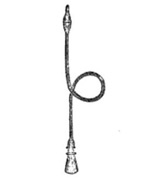
| Golding Bird (1814–1854) 1840 |
 © Wellcome |
British doctor Golding Bird created a version of the stethoscope with a fully flexible tube that he called the ‘snake ear trumpet.’
|
||
 |
||||
| Acoustic chairs Mr Curtis' chair 1841 |

|
|||
| Willaim Blackmore Pine 1849 |
 |
‘The Mimosa or Flower Cornet’ registered for W B Pine of London |
||
| Illustration 1850 |
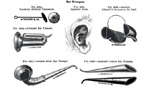
|
|||
| F C Rein ~ 1850 |
 © WUSM |
'Floral Aurolese Phones' in the shape of a flower made by Rein. Credited to 1800 but there is no evidence that it is that early. |
||
| John Emslie (1813-1875) 1850 |
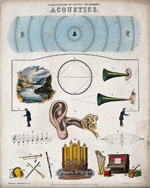 |
Acoustics: sonic phenomena and musical instruments. Coloured engraving. |
||
| Shell ear trumpet 1850 |
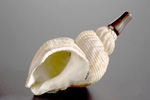 |
I have 2 examples of Victorian ear trumpets.
#49 #263 |
||
| Arthur Leared (1822–1879) 1851 |
 |
Irish physician Arthur Leared invented a version of the conversation tube that fitted into both ears. Made of a tough plastic substance called gutta-percha, this first binaural stethoscope was displayed at the Great Exhibition in London in 1851. |
||
| Bonnafont 1851 |
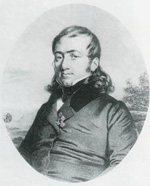 |
Jean Pierre Bonnafont (1805–1891) invented this design. Bonnafont decided the extreme length of some ear trumpets then in current use both inconvenient and unnecessary. |
||
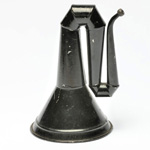 |
He folded the tube of the trumpet into four right-angles to make a much more compact ear trumpet. | |||
| Galante 1851 |
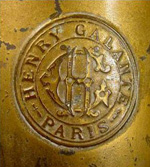 |
Surgical equipment manufacturer starts up and ceases trading about 1935. I have a walking stick supplied by this company see #424. |
||
| Patent application E G Hyde 1855 |
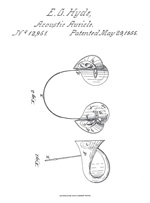 |
First patent in the USA for a hearing aid is issued to Edward G. Hyde of Camptown, New Jersey for a pair of auricles. A typical Rein example |
||
| F C Rein 1855 |
 |
Presents 18 different trumpets at the Exhibition Universal. | ||
| Patent application E G Hyde 1857 |
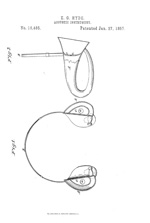 |
Later version of Hyde auricles.
|
||
| F C Rein Ear tube 1860 ? |
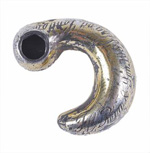 |
A rare 19th Century silver gilt conch hearing aid by F.C. Rein & Son of 108 The Strand, London. (details engraved on item). Examples exist in private collections and a gold example is held in the Boston Museum. |
||
| Edward Miner Gallaudet (1837-1917) 1864 |
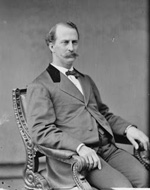 |
Responsible for the National Deaf-Mute College which opened in June of 1864. | ||
| Maw catalogue 1866 |
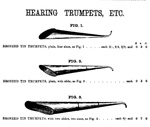 |
|||
| T Hawksley 1869 |
 |
Opening in 1869 Hawksley invented, produced and sold a wide range of 'Otacoustical instruments to aid the deaf' in Victorian Britain.
|
||
| Tiemann catalogue 1874 |
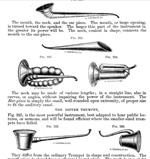 |
|
||
| Epping Chair 1875 |
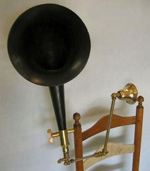 ©Worthpoint |
Thought to be unique and probably manufactured between 1850 and 1900. This chair has been fully restored for an unknown collector. |
||
| Hawksley 1875 |
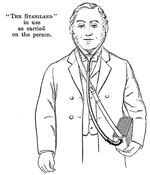 |
According to Dr. Goldstein in his 1933 book, Problems of the Deaf, this unusual device was called a water canteen receptor. Dr. Goldstein writes that this device was custom-made around 1875 by Thomas Hawksley for a deafened African rubber planter who desired a portable, yet camouflaged, hearing device that could be used while on horseback supervising the workers on his plantation. |
||
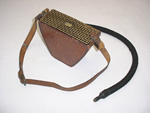 |
The device, disguised as a water canteen, was intended to be worn on the body with a shoulder strap for support. The sound was collected at the open grillwork and conveyed through a single rubber tube held by the user to his ear. ©Becker |
|||
| Hawksley 1875 |
 |
This black metal table instrument is about twelve inches tall. Built about 1875, by Thomas Hawksley, it is intended for use on a table. A silk covered rubber tube leading to the user’s ear was perhaps concealed with a tablecloth, table runner or napkin. |
||
| A G Bell 1876 |
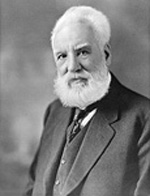 | Alexander Graham Bell invents the telephone. |
||
| Arnold catalogue 1876 |
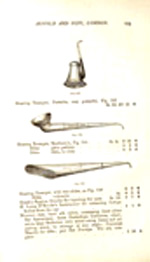 |
|
||
| Japan 1877 |
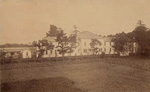 Tokyo school for the deaf |
The first school for the deaf in Japan is established. |
||
| McKeown Chair 1879 |
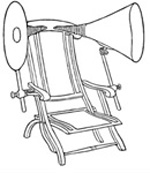
|
No examples exist |
||
| R S Rhodes Patent application 1879 |
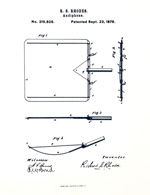 |
Richard Rhodes, of Chicago, Illinois, invents and patents a hearing fan, which he calls the Rhodes Audiphone. The upper edge of the fan was held against the user's upper teeth. |
||
| Rhodes 1879 |
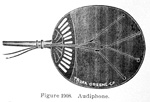 |
Rhodes constructed which transferred sound vibrations through bone conduction by the subject held against the teeth or between the teeth He made an audiophone in Chicago from natural shells. Image is from 1908 Truax catalogue. |
||
| W W Bostwick Patent application 1879 |
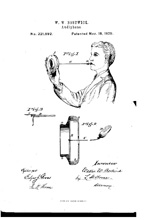 |
Walter Bostwick patents an 'improvement in audiphones' |
||
| Thomas Graydon 1879 |
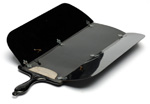 |
Patents the Dentaphone. Another one pressed to the teeth. |
||
| Aubry catalogue 1880 |
 |
|
||
| Hawksley 1880 |
 |
The Thomas Hawksley Company in particular went to great lengths to design hearing devices that could be incorporated into everyday items or worn on the person in an attempt to appease the vanity of the user.
The ingenuity and taste of the instrument maker are required to construct mechanical aids to hearing which shall combine gracefulness of form and appearance without detracting from their efficiency. |
||
| Patent application S North 1880 |
 |
Print of ear trumpet London Dome patent. I have an example |
||
| Catalogue image 1880 |
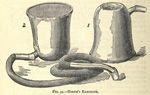 |
Two examples of North's trumpet. | ||
| Alfred Marshall Mayer 1880 |
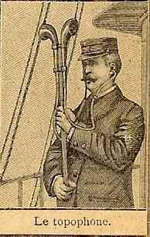 |
Invents the Topophone - dual trumpet for detecting noisy enemies. After discussion at Becker I realised this is also a stereo device ! |
||
| Professor Mayer 1880 |
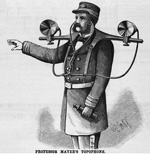 |
A different version, Prof Mayer uses the term topophone generically. |
||
| Giovanni Paladino Naples 1880 |
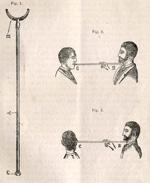 |
The Fonifero OF THE ARRIVAL OF THE VOICE AND OF THE WORD TO THE LABYRINTH IN CROSS THE BONES OF THE SKULL |
||
| Franck Valery 1881 |
 |
Introduces combination trumpet and spectacles at the International Exhibition and ceases manufacture 1940 |
||
| Patent application H Waldstein 1882 |
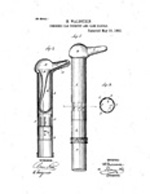 |
Combined ear trumpet and cane handle
|
||
| James A. Campbell 1882 |
 © Becker |
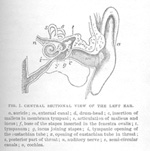
Helps to Hear This work by James Campbell, a professor in the Homeopathic Medical College of Missouri, contains a discussion of the anatomy of the ear, the nature of sound, and descriptions of all the various hearing devices of the day. 'The deaf are, as a rule, very sensitive over their infirmity, and hence dislike any instrument which is conspicuous, or makes this condition more apparent; for this reason many other devices have been invented, which seek to conceal this fact . . .' |
||
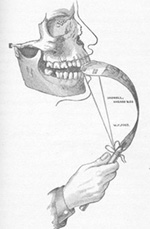 |
'What spectacles are to the eye, the ear trumpet should be to the ear; but while the adaptation of glasses to correct the optical defects of the eye, may be considered as one of the complete sciences, with but little more to be desired, the science of Acoustics is still far from furnishing the help required, in the application of its principles to aid defective hearing.' |
|||
| Patent application A Macdonald 1882 |
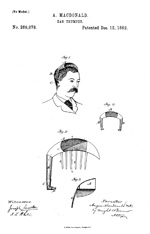 |
Comb style ear trumpet |
||
| Queen Victoria 1883 |
 |
Victoria signing with deaf children. |
||
| A Politzer (Vienna) (1835-1920) 1883 |
 |
Based on Helmholz theory he invented the 2 parabola trumpet known as the 'banjo' view my collection See also the Banjo conundrum |
||
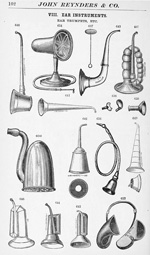
| Variety of trumpets illustrated by John Reynders 1884 |
|
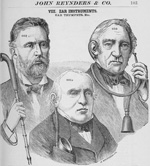
I have an 1884 Reynders catalogue. |
||
| 1884 | 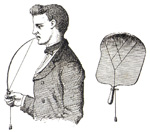 |
Rhodes hearing aid. Published in Ganot (1884)
|
||
| Reynders catalogue 1884 |
 |
|
||
| D. B. St. John Roosa (1838-1908) 1885 |
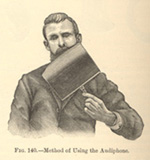 |
Roosa reports of an instance of watering of the eyes by a patient when using the Rhodes Audiophone as illustrated. |
||
| Curriers Duplex 1885 |
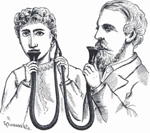 |
Variations of conversation tubes are developed with the Duplex Conversational Tube. The device allows the hearing impaired listener to hear their speaker, as well as their own voice. |
||
| Patent application J A Maloney 1887 |
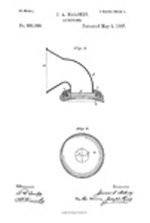 |
Ear trumpet with a diaphragm earpiece is patented by James A. Maloney in the United States. Very similar to the item made by Globe and one or two others. |
||
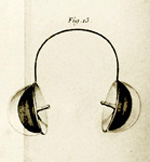
| Laurence Turnbull (1821-1900) 1887 |

© image Becker |
Illustration of a variety of French hearing devices, from: Laurence Turnbull’s A clinical manual of the diseases of the ear. 2nd edition, revised. Philadelphia: J.B. Lippincott Company, 1887 (p. 54).
NB the telescopic is like my item #182 |
||
 © image Becker |
|
|||
 © image Becker |
|
|||
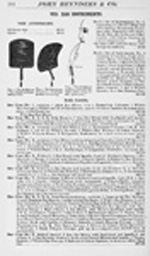
| Reynders catalogue 1889 |
 |
|
||
| Early entertainment 1889 |
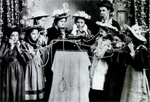 |
The first jukebox was unveiled in a saloon in San Francisco by Louis Glass. The machine had four different stethoscopes attached to it that functioned as headphones. |
||
| Tieman catalogue 1889 |
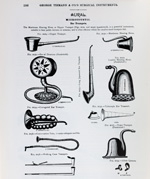 |
|||
| Adam Politzer (1835-1920) 1894 |
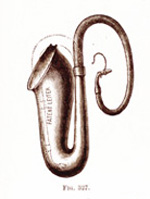 |
Politzer’s text-book of the diseases of the ear : The number of those who prize ease of social intercourse so highly that they pay no regard to the discomfort and conspicuousness of large ear-trumpets is very small. |
||
 |
Nonewithstanding the advantages possessed by large instruments, they are generally discarded on account of conspicuousness in use. |
|||
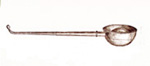 |
The ideal of all deaf people has always been a small instrument which could be worn unobservedly in the ear, and render at the same time the same service as the largest instrument. |
|||
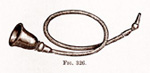 |
This problem has not yet been solved, and will not be so easily
|
|||
| Gherardo Ferreri 1899 |
|
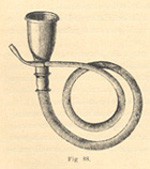
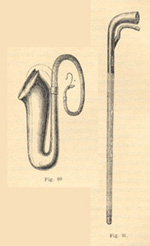
A number of trumpet type hearing aids introduced in 1899 by Italian Ferreri.
|
||
 |
|
|||
 |
|
|||
| Patent application J Boyd 1890 |
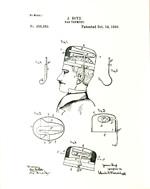 |
Print of ear trumpet hat patent | ||
| Quack hearing aid advert 1890 |
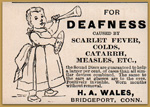 |
Sadly in late Victorian times, there were many offers of gadgets to improve hearing that did no good whatsoever. |
||
| Patent application F M Blodgett 1890 |
 |
Beautiful Art Nouveau
auricles - supplied in an elegant tin |
||
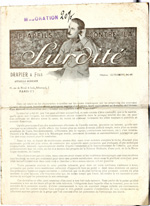
| 4pp French catalog by Drapier with prices ! 1890 |
|
|||

|
||||

|
||||

|
||||
| Patent application A E Miltimore 1892 |
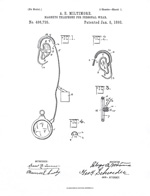 |
First United States patent for an electric hearing aid is issued to Alonzo E. Miltimore of Catskill, New York for a 'magneto telephone for personal wear'. The device was never produced. |
||
| Patent application W G A Bonwill 1892 |
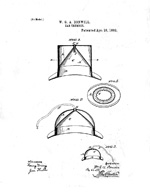 |
Curious idea which never seems to have seen the light of day.
|
||
| Down catalogue 1892 |
 |
|
||
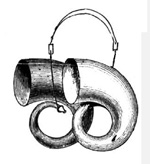 |
These horns were worn by my granny. Looming over her head they were quite frightening. At 6 years old noone had told me that they came off to go to bed ! |
|||
| Truax catalogue 1893 |
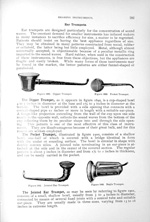 |
|
||
| Montgomery Ward catalogue 1895 |

|
|
||
| Adolphe Pinard (1844-1934) 1895 |
 |
Pinard a French obstetrician invented a special stethoscope for listening to foetal activity. |
||

early Pinard |
The monaural stethoscope is much earlier. Pinard is credited with this funnel shape. | |||
| Dentaphone instruction sheet 1895 |
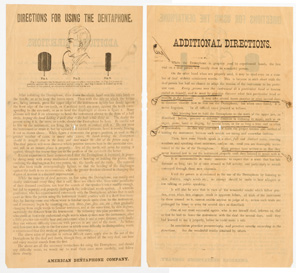
|
view the device #100 |
||
| Patent application G J Wainwright 1896 |
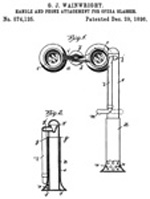 |
Ear trumpet handle designed to fit opera glasses. |
||
| Sears Roebuck catalog 1897 |
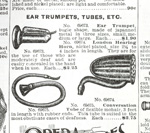
|
|||
| Advert Wm V Willis 1898 |
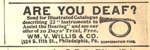 |
Conversation tube shown in classified advertisement. |
||
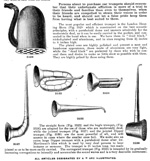
| Armstrong catalogue 1901 |
 |
|
||
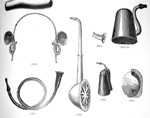
| Stille catalaogue 1901 |
 |
|
||
| Sears Roebuck catalog 1902 |
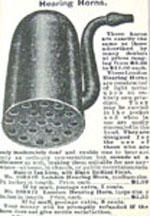 |
Images at Hearing Aid Museum |
||
| Patent Application T W Messenger 1903 |
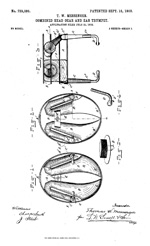 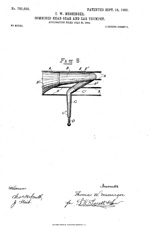 |
Boater hat ear trumpet
|
||
| Arnold catalogue 1904 |
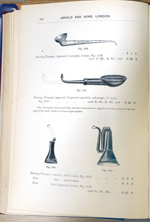 |
|
||
| Herman G Pape Patent application 1904 |
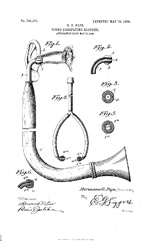 |
Pape presents an application for a conversation tube which has a 'sound dissipating earpiece'. |
||
| A C B Jewelers' 1904 |
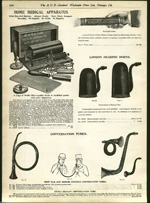 |
Chicago, Illinois.
|
||
| Patent application G G Lewis 1905 |
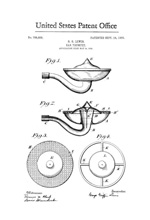 |
Ear trumpet, remniscent of the banjo
|
||
| Reynolds catalogue 1905 |
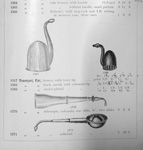 |
Catalogue dated 1884 is the earliest one I have |
||
| Seth Scott Bishop (1852-1923) 1906 |
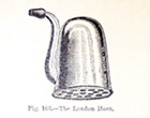 |
Bishop recounts a conversation with Alexander Graham Bell where Bell related that his discovery of the telephone was related to trying to invent a microphone to aid the deaf. Bishop asked Bell if it were possible to construct an instrument for defective hearing comparable to the lens for defective vision. Bell replied, 'I will not say that it is impossible, but in the present state of our knowledge, it is improbable'. |
||
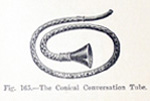 © Becker |
According to Bishop only two hearing devices have proven to be of any practical value. The two are the London Horn and the conical conversation tube as illustrated in Bishop’s work. |
|||
| Globe 1907 |
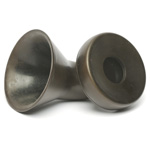 |
The Globe Ear-Phone Company opens in Boston. | ||
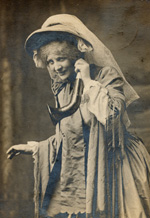
| Miss Dorothy Dale from a postcard 1908 |
|
I have the original postcard postmarked 1908. |
||
| Advert by Sears 1908 |

|
I have not matched this picture to particular source, I am confident it is a resale item. |
||
| Truax catalog 1908 |
|
This is one of many different types of teeth conduction based 'ear trumpets' |
||
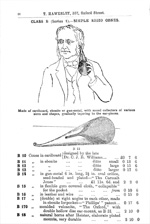
| Page from Hawksley catalog 1909 |
|
|||
| Thomas Barr (1846-1916) 1909 |
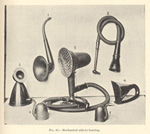 |
Manual of Diseases Small instruments, invisible during use, for augmenting the hearing power are in great request by deaf persons, who, in consequence of their inclination to conceal their infirmity, dislike and delay the employment of somewhat conspicuous devices . . . |
||
| Hawksley auricle 1909 |
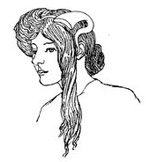 image Robert Weinkove |
View an item that may have been worn this way |
||
| KWS catalogue 1909 |
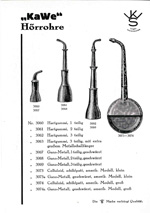 |
This prolific maker had a wide range of items.
|
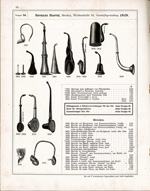
||
| Haertel catalogue 1910 |
 |
|
||
| Kirchner 1910 |
 |
Kirchner & Wilhelm in Asperg offered various stethoscope models in their catalogue. This example from that period is a telescopic 2pc - click magnify to see catalogue page |
||
| Hood Tale of a trumpet 1911 |
 |
Sales techniques and death of a witch described in Hood's poem | ||
| Franck-Valery 1911 |
|
Franck-Valery Freres of Paris begins making carbon hearing aids. This is a Victorian eyefone - spex and trumpet combined. |
||
| Lentz catalog 1911 |
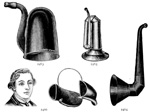 |
|
||
| Detail from Luer catalog 1912 |
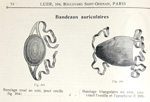
|
|||
| Catalogue page 1913 |
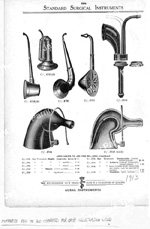 |
K N Y Sheerer & Co catalogue page. |
||
| Maw catalogue 1913 |
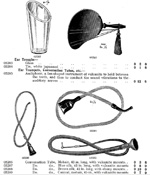 |
|
||
| Theodore Heiman (b. 1848) 1914 |
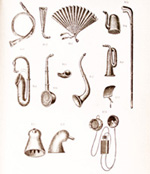 |
Heiman’s work from 1914 contains illustrations of hearing devices, including an early electronic device. |
||
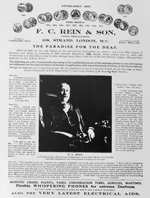
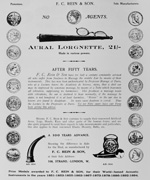
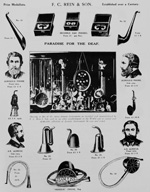
| 6pp from Rein catalog 1914 |
|
|||
|
||||
|
||||
|
||||

|
||||
| Advert B. A. Co 1915 |
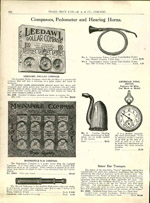 |
Conversation tube and London dome |
||
| Vintage French print published 1920's |
 |
|||
| Joseph Prenn Patent application 1920 |
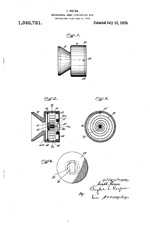 |
Patent awarded to Prenn for 'Mechanical bone-conductive ear' which looks rather like a Meyrowitz diaphragm unit. |
||
| Earl Hanson 1921 |
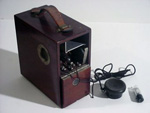 image credit |
Hanson built an electronic Vactuphone later produced by Western Electric. |
||
| Western Electric 1921 |
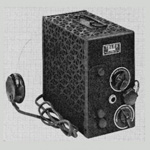 |
The production version of the Vactuphone.
|
||
| Early hearing aid 1923 |
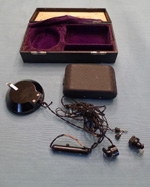 image Worthpoint |
The Marconi Company of England and Western-Electric of the United States introduce vacuum tube hearing aids. This is a circa 1925 model. |
||
| Vintage print published 1923 |
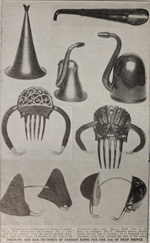
|
I have a copy of this print |
||
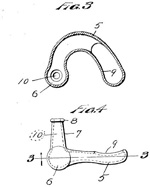
| USA patent 1556774 1923 |
|
Charles Fensky patents Audiphone. Later goes on to raise several more patents for useless ear tubes. |
||
| Vibraphone 1924 |
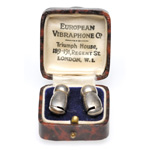 |
These tiny ear tubes were useless, but in 1924 were being sold with a coating of Radium to improve their performance !! | ||
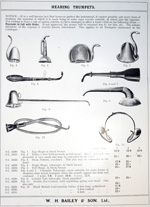
| Bailey catalog 1925 |
 |
|
||
| Adelaide Claxton (1841-1927) 1925 |
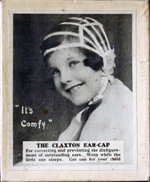 corrective ear cap of pink ribbon, elastic and net in box, patented by Claxton |
Worn by babies and young children as they slept, this pink ribbon ear cap was 'for correcting and preventing the disfigurement of outstanding ears'. Patented by Claxton, the advertisement promised that the cap would prevent ‘ugly’ ears. Ear caps first appeared in the 1890s. |
||
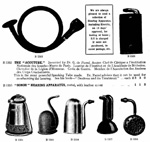
| SMC catalogue 1928 |
 |
|
||
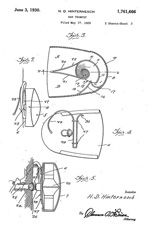
| Patent application Herman D Hinternesch 1929 |

|
The present invention relates to devices closed my invention as comprising- a substane for aiding a persons hearing, commonly known as ear trumpets and comprises essentially a casing adapted to fit upon the ear of the person having intake and discharge ends and providing air passages within the casing between said intake and discharge ends for condensing the sound waves passing therethrough before the same enters the ear orifice. |
||
 |
||||
| Catalogue detail 1929 |
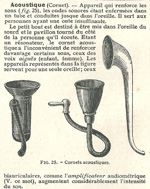 |
Trumpet details by Larousse. |
||
| Vibraphone 1931 |
|
Charles Fensky 'improves' audiphone with vibrating reeds and calls it the vibraphone - manufactured by Vibraphone. | ||
| F C Rein Letterhead 1932 |

|
|||
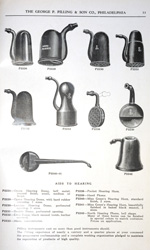
| Pilling catalogue 1932 |
 |
|||
| Max Aaron Goldstein (1870-1941). |
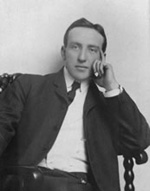 |
Goldstein wrote 'Problems of the deaf', it is among the premier classic works in the field of deaf education. He founded the CID. |
||
| Edmund R Butts Patent application 1933 |
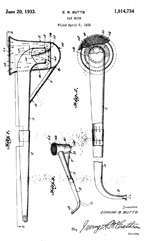 |
Patent awarded to Butts for a large dome described as an 'Ear horn'. The new bits seem to be the pointy reflector and a screen. |
||
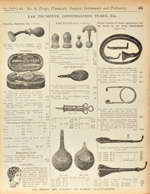
| Army & Navy catalogue page 1939 |
|
I have a copy of the catalogue page.
|
||
| UK National Health Service (Medresco) begins 1947 |
 |
R J Dowling London dome dated June 1950 | ||
| Product life 1949 |
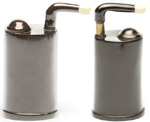 |
These two trumpets are physically very similar. The one on the right is either a poor quality example or has been subjected to heat because it quite distorted. The earpiece material suggests it is old - maybe 1900 is a fair guess. The one on the left is Mears dated 1949 ! |
||
| William C. Stokoe 1960 |
 |
Stokoe published a breakthrough monograph that "legitimized" American sign language once and for all. | ||
| F C Rein 1963 |
 |
Ceased manufacture of ear trumpets. A huge dome by Rein from my wishlist |
||
| Maximilian Weil Patent application 1964 |
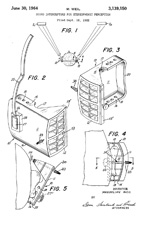 |
Application awarded to Weil for
'Sound interceptors for stereophonic perception' which are a bit reminicent of ones by Rochausen. |
||
| Gilbert R Calkins Patent application 1968 |
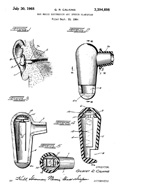 |
Calkins files an application for an 'Ear noise suppressor and speech clarifier', which looks very like an early ear tube. |
||
| Product life 1971 |
 |
This Eschmann tapered conversation tube was made in the UK right up to 1976. This one is physically dated 1971. F C Rein made an almost identical item (shown in their 1914 catalogue) from about 1870 !! |
||
| Latest year found on a Medresco trumpet 1976 |
 |
Mar 76. The NHS took delivery of 20,000 units in 1976. I was in my mid thirties in '76 and never saw a person in public with a trumpet but plenty of pink plastic thermionic valve based units. Hearing Aid Museum has an OL38001 dated 7  76 76 |
||
| 1982 | 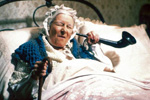 |
Rose Hill playing Madame Fanny La Fan in 'allo 'allo! on BBC TV. |
||
| Stevens & Goodwin 1984 |
 |
Non-Electric Aids to Hearing: A Short History Excellent work on the history of ear trumpets. Available as a PDF file. |
||
| Shawn T Brown Patent application 1988 |
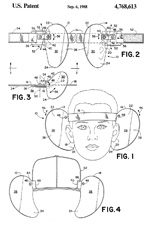 |
Brown awarded patent for big ears ! Described as 'Directional hearing enhancement', they look like joke ears to me. |
||
| James P Dudley Patent application 1997 |
 |
Dudley, Fields and Landis file patent for
'Passive sound gathering apparatus'. |
||
| Young S Lee Patent application 2000 |
 |
Lee patent an
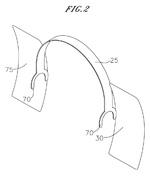
'Article for collecting sound for ears' |
||
| How I started | ||||
| How it all started for me 2001 |
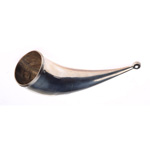 |
This was my first trumpet. A present for a major birthday. An expensive fun present for a deaf person - it does not work very well ! |
||
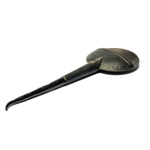 |
Some months later, I came across this and bought it in the USA. | |||
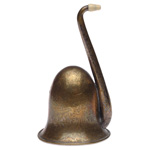 |
Then my wife found this one at a local auction. | |||
 |
Quite by chance I discovered this conversation tube on Ebay and bought it because I was fascinated by the difference in design from the other ones I had. | |||
 |
Then I found my first banjo and was completely hooked. As an engineer, one felt that the optimum design should evolve and be similar by all makers. This is not the case and couple the variety in real items with both quack ones and other objects used by deaf people that were never intended as ear trumpets and you have the basis of a collection! |
|||
|
Subsequently I discovered the NHS was issuing a conversation tube in 1976 identical to one made 100 years earlier. This example is dated 1971. |
|||
| New trumpets ! 2013 |
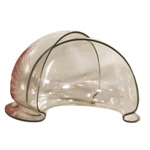 |
As recently as 2013 yet another variation using modern plastics is being sold on Amazon. | ||
| 2014 | 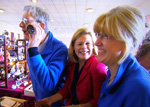 |
Website author with Kate Bliss and embroiderer Alison Holt on Bargain Hunt negotiating a lower price and using a Rein trumpet. |
||
| 2016 |  |
Packington Collection celebrates Guinness World Record for the largest collection of ear trumpets. | ||
| Evelyn Waugh's trumpet sells again 2017 |
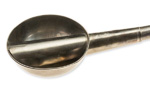 |
The plated copper English-made telescopic ear trumpet was snapped up at a hammer price of £2200, more than double its low estimate, at Forum Auctions' Fine Books and Works on Paper auction on March 30 at The Westbury Hotel in central London. | ||
| 2017 |  |
Packington Collection celebrates a total of 401
items as the year begins, the current total is
564. Picture is my 6th walking stick. |
||
| 2018 | 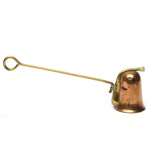 |
This unusual trumpet was a recent addition. I have never seen a handle quite like this on a London dome. At the end of 2018, the Collection celebrates a total of 450 items with the current total being 564 items. Visit my favourites in the collection. |
||
| 2019 |

|
Collection featured on BBC1's Curiosity dated 2nd April 2019. In February during filming the collection was 457 items. |
||
| 2019 |  |
This website accepted by UKWA on 2nd Apr 2019 for inclusion in the British Library web archive. | ||
| 2019 Sep |
This year has seen many surprises, a whole page of them. |
2019 - read more... | ||
| 2020 May |
This year is rapidly becoming interesting ! | 2020 - read more... | ||
| 2021 April |
Another very interesting year | 2021 - read more... | ||
|
If you know something is wrong please let me know. Other internet resources on history Rare books at Becker - the best resource that I have found Problems Hearing |
||||



)
)
)
)
)
)
)
)
)
)
)
)
)
)
)
)
)
)
)
)
)
)
)
)
)
)
)
)
)
)
)
)
)
)
)
)
)
)
)
)
)
)
)
)
)
)
)
)
)
)
)
)
)
)
)
)
)
)
)
)
)
)
)
)
)
)
)
)
)
)
)
)
)
)
)
)
)
)
)
)
)
)
)
)
)
)
)
)
)
)
)
)
)
)
)
)
)
)
)
)
)
)
)
)
)
)
)
)
)
)
)
)
)
)
)
)
)
)
)
)
)
)
)
)
)
)
)
)
)
)
)
)
)
)
)
)
)
)
)
)
)
)
)
)
)
)
)
)
)
)
)
)
)
)
)
)
)
)
)
)
)
)
)
)
)
)
)
)
)
)
)
)
)
)
)
)
)
)
)
)
)
)
)
)
)
)
)
)
)
)
)
)
)
)
)
)
)
)
)
)
)